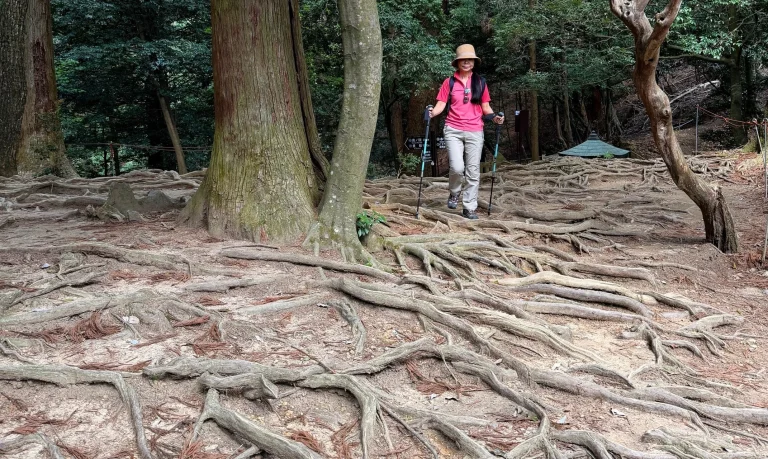
Five years ago, I walked the entirety of the ancient road known as the Saba Kaido, or Mackerel Highway, which connects the former capital of Kyoto to the sea. My companions and I took three days to trek from the fishing port of Obama, over the Central Watershed Divide, and down into Kyoto’s mountain-ringed basin. Our purpose was to assess the viability of the route as a hiking trail for inbound tourism. While several remarkable sections of the original trail survive, much has long since been paved over by modern roads.
For this reason, and selfishly because of my own love of cycling, I decided to focus my efforts on developing a cycling route rather than a long-distance hiking trail. Since then, however, I have returned to the Saba Kaido many times on foot. I have joined an annual walking tour composed mostly of retired hiking enthusiasts, and helped chaperone local elementary school students who walk one-third of the route each year over the course of three years, continuing a tradition that connects them to the history and geography of their region.
A Network of Roads Between the Sea and the Capital
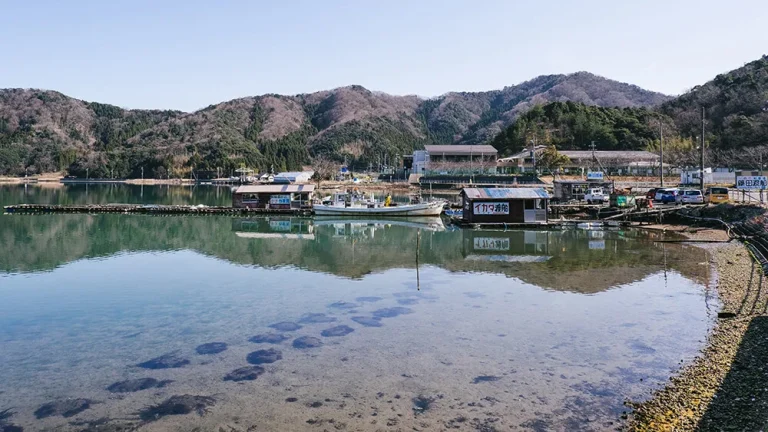
The Saba Kaido was not a single road but a network of routes connecting the once-bustling seaport of Obama with Kyoto. For centuries, merchants, pilgrims, monks, fishermen, and travelers crossed the mountains carrying salt, fish, stories, and ideas between the coast and the capital. The route is said to have earned its nickname because fresh mackerel caught in Wakasa Bay could be relayed to Kyoto overnight, arriving in time to be sold in the city’s markets. Yet fish was only one part of the story. The Saba Kaido also served as a vital artery linking the cultures and technologies of the Asian mainland with the political, cultural, and spiritual heart of Japan.
A New Journey with an Old Purpose
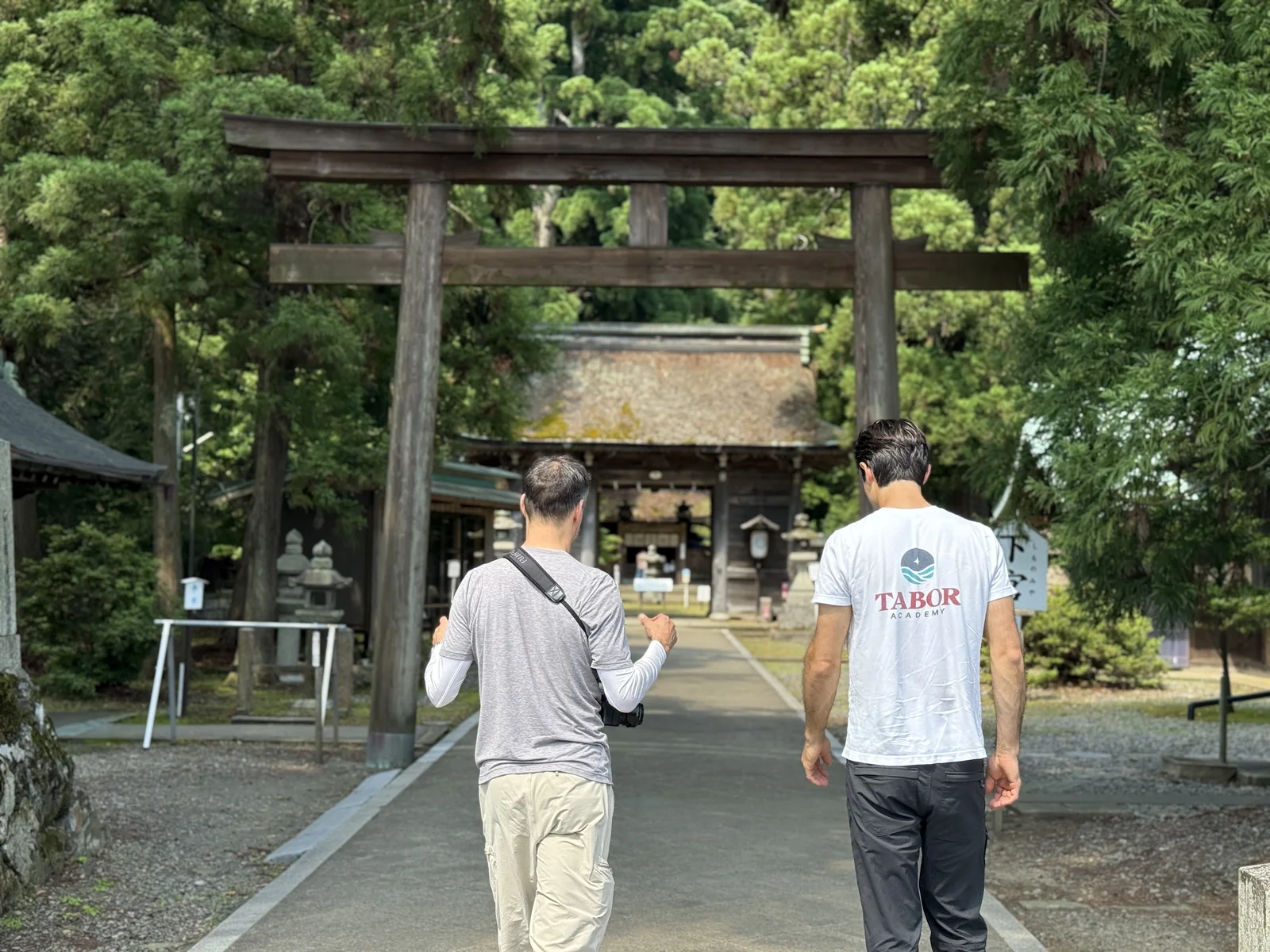
I was given another opportunity to revisit a portion of the route when Keijiro Sawano, founder of Heartland Japan, invited me to guide Jonathan, Director of Global Education at Tabor Academy in Massachusetts. Known as the “School by the Sea,” Tabor has a strong focus on marine studies and sailing. Jonathan had come to Obama to explore a possible exchange program with Wakasa High School, which also offers programs in marine studies, as well as the potential for a future school trip incorporating some of the most scenic and historically significant sections of the Saba Kaido.
Although the weather forecast called for rain, we were blessed with two clear spring days that seemed designed for walking.
Day One: From Wakasahime Shrine over Onyu Pass
Day one began at Wakasahime Shrine—an appropriate starting point, as the shrine is closely tied to the myths surrounding both the Saba Kaido and the origins of Wakasa itself. According to legend, the fisherman deity Wakasahiko encountered the sea deity Wakasahime, and their union gave both the shrine and the region its name.
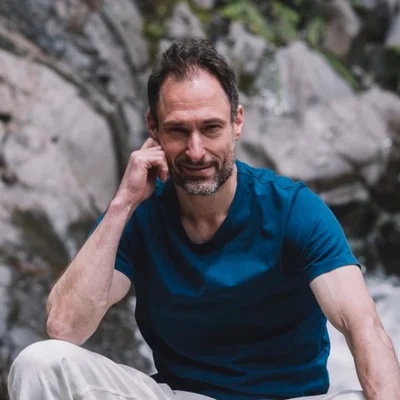
After offering a prayer for a safe journey beneath the thousand-year-old cedar towering above the shrine, we were preparing to leave when an elderly woman emerged from a house across the street. Jonathan, who resembles a young Christian Bale, seemed to fascinate her immediately. She spoke fondly of a trip she had made to America in her youth, then darted back inside and returned carrying a few faded photographs from her journey to show us, along with an offering of two chilled cans of coffee from her refrigerator.
With this auspicious send-off, we climbed back into the van and headed for our next stop: Jingu-ji.
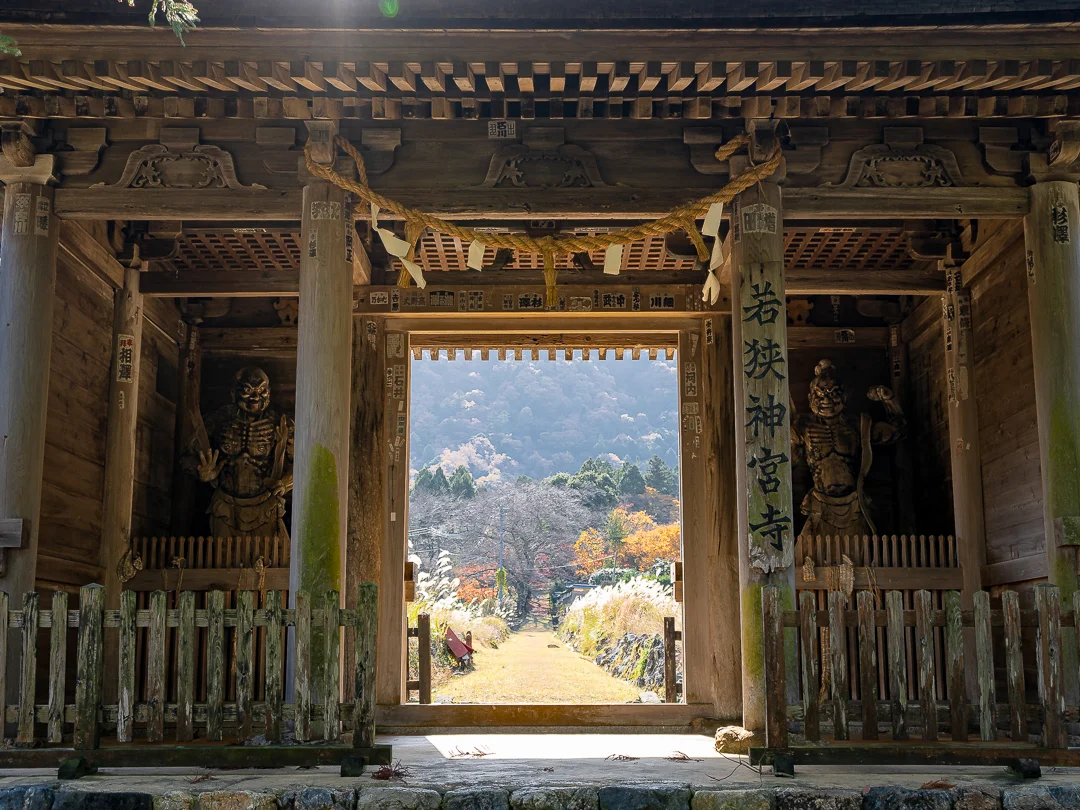
Passing between the imposing Myō-ō statues that guard the approach, I explained the history of shinbutsu shūgō—the centuries-long blending of Buddhism and Shinto—and how Jingu-ji survived the anti-Buddhist policies of the Meiji era that dismantled so many shrine-temple complexes throughout Japan. For visitors unfamiliar with Japanese religious history, the survival of places like this offers a rare glimpse into a worldview that once saw mountains, rivers, deities, and Buddhas as part of a single sacred landscape.
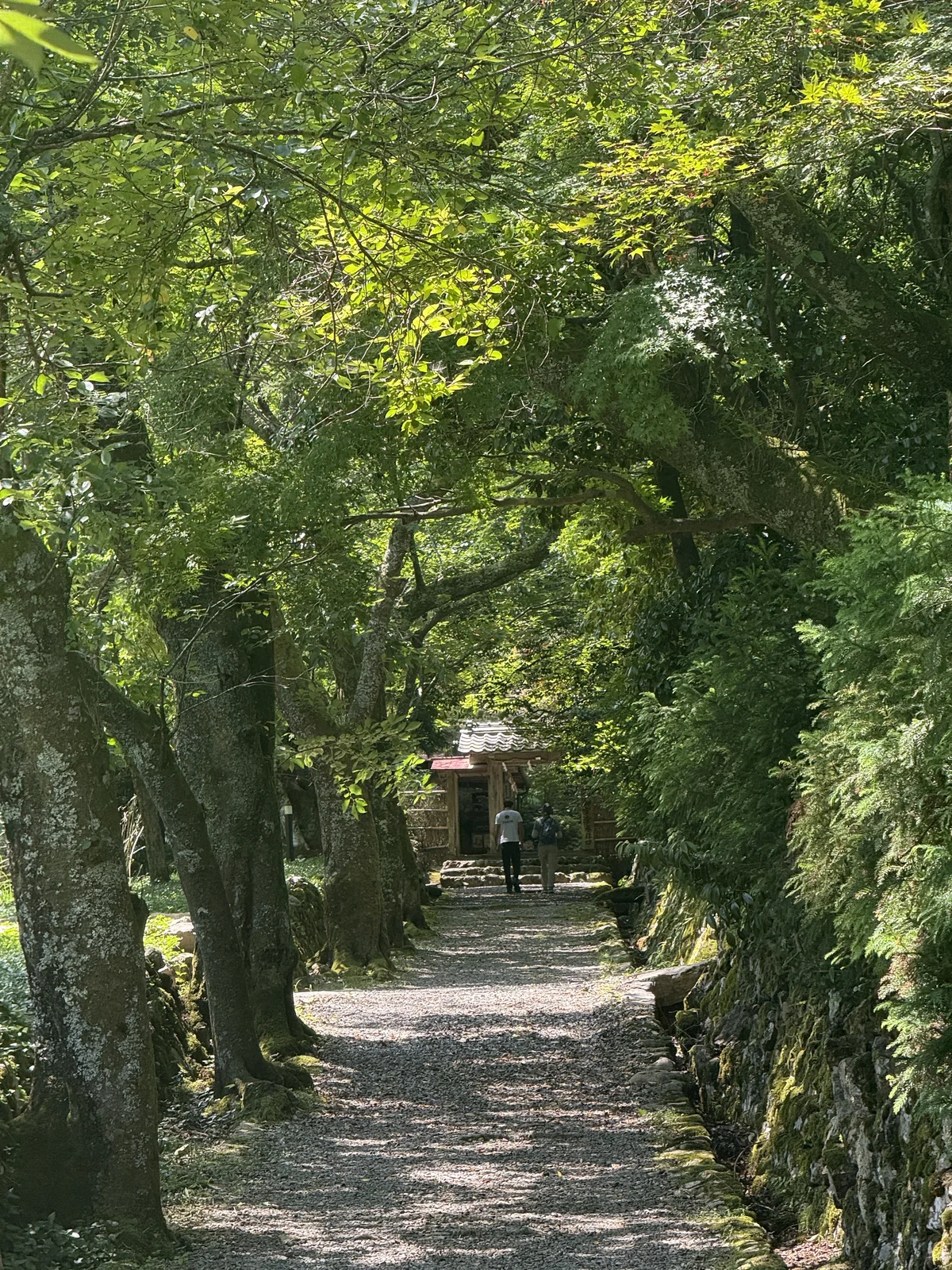
From Jingu-ji, we continued on foot through the surrounding countryside, following the river past the quiet hamlet of Shimonegori and then climbing steeply to the now-abandoned hamlet of Kaminegori. “Shimo” and “kami” refer to lower and upper, respectively. The origin of “Negori” remains something of a mystery. One theory links it to the Negoro-shū, a medieval sect of firearm-wielding Buddhist monks. Another suggests a connection to the Korean ne-kori, meaning “native village,” a reminder of the close ties that once linked Wakasa with the Asian mainland. Whatever the origin of its name, Kaminegori today is inhabited only by ghosts.
The narrow road, completely bereft of cars, eventually led us to the trailhead, where we entered the forest and began ascending the original route of the Saba Kaido itself.
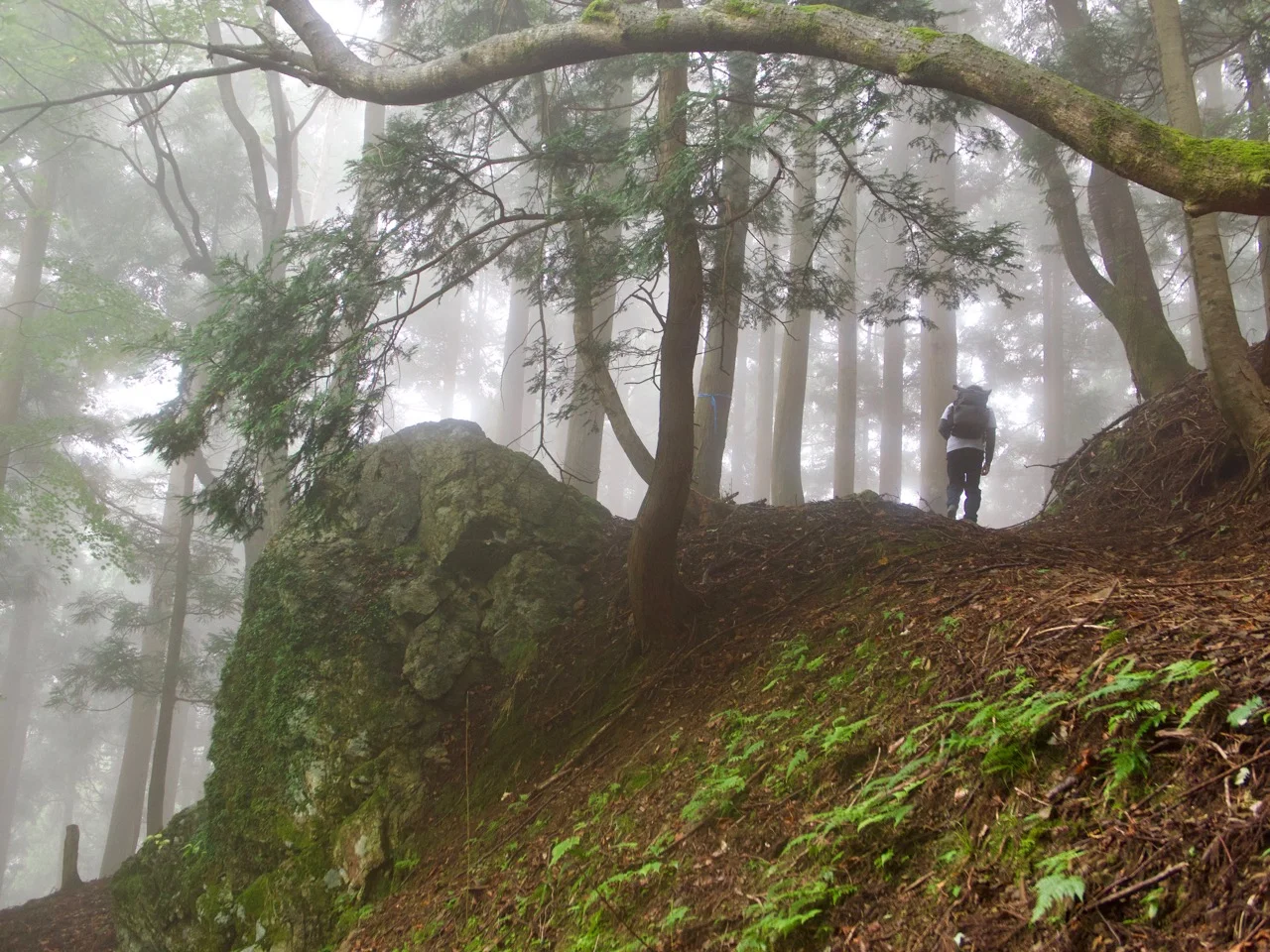
After climbing a series of switchbacks through dense cedar plantations, we entered a more varied forest of deciduous trees, where shafts of sunlight splashed across the forest floor. Here I taught Jonathan the word komorebi, the Japanese term for sunlight filtering through leaves. As a fellow New Englander with a deep curiosity about Japan, he was easy company, and our lively conversation served both to shorten the journey and frighten the bears away. As we approached Onyu Pass, centuries of footsteps had worn the trail into a gully so deep that it was impossible to see over its banks.
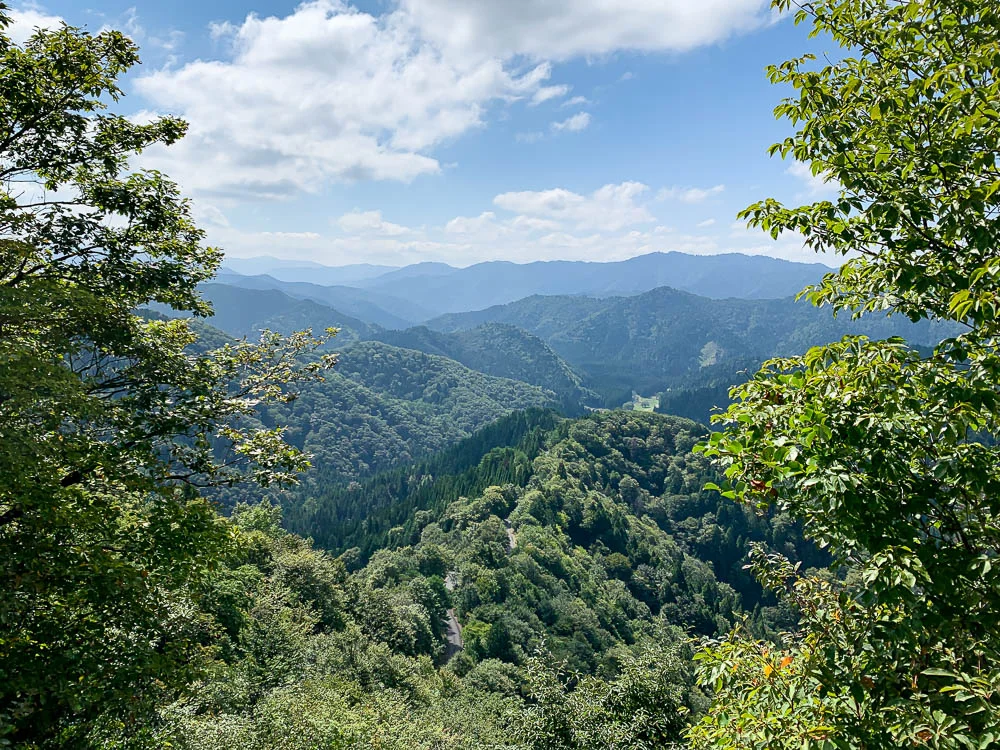
From the pass, the mountains stretched away in layers, each ridgeline fading into a deeper shade of blue-green as it receded into the haze and merged with the sky. After taking in the view, we began our descent into the Onyu Valley.
Nestled deep in the mountains, Onyudani feels largely untouched by time. A handful of centuries-old kayabuki thatched farmhouses remain scattered along the valley floor, surrounded by rice fields, vegetable gardens, and forested slopes. Though only a couple of hours from Kyoto, it seems a hundred years away from the pace and concerns of modern life.
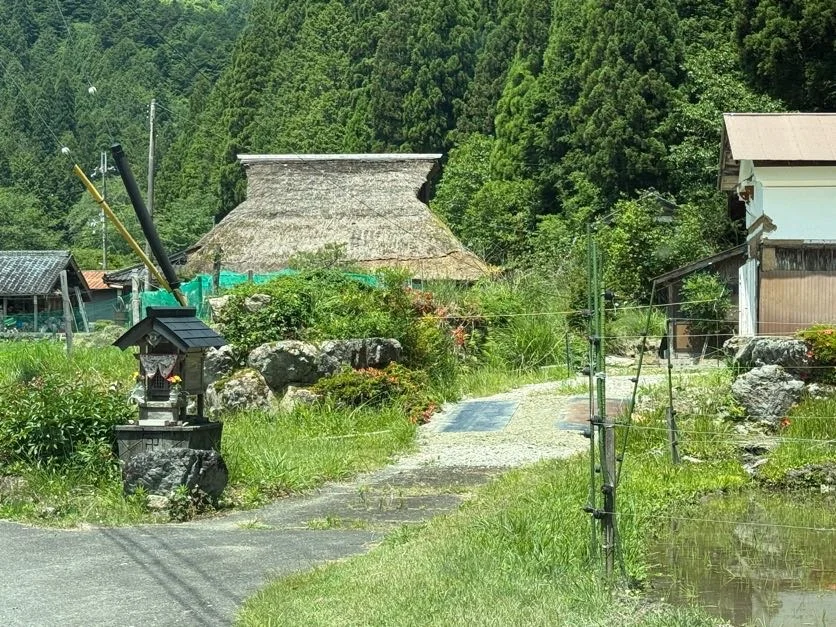
Entering the village, we were greeted first by the dog, and then by the owner of Haruya, a small guesthouse known for its vegetarian farm-to-table cuisine prepared largely from produce grown in her own garden. She remembered me from previous visits, and the dog seemed to as well. Not much had changed since the last time I passed through, though there was one notable difference. The duck that once wandered the property had been replaced by a lamb. The duck, she explained, had lost an encounter with a fox.
We continued along the single narrow road that passes through the village—the old Saba Kaido—winding beside the shimmering Harihata River. Apart from the sound of the water and the occasional bird call, the valley was dead silent.
Soon we came to the community facility at the far end of Onyudani, where Keijiro was waiting with his van. Once again ensconced in the soft, air-conditioned interior, we transferred to the nearby hot spring town of Kutsuki, where a pair of rustic bungalows and a hot spring to dissolve the day’s fatigue awaited us.
An Evening in Kutsuki
As I eased myself into the steaming water, I was surprised to discover another foreigner soaking nearby. Visitors from overseas rarely venture as far as Kutsuki. He seemed even more surprised to find us there. After introducing himself, he explained that he had been living in Kutsuki for nearly forty years.
Having grown disillusioned with his work teaching English at a university in Kyoto, he had recently retired and now devoted his time to making pottery. He maintained his own studio and kiln in this tiny post town that had become his home, and he spoke enthusiastically about its past. Once an important castle town, Kutsuki’s streets were deliberately laid out to defend itself from invading armies. He also pointed out the old Maruhachi Department Store, built in 1933, which had long since ceased operating as a department store and had found a second life as a café.
The following morning, curiosity—and the only other viable option being a Lawson’s—led us there for breakfast.
Inside, we were pleasantly surprised to be served thick slices of fresh homemade bread, locally made jam, and a choice of fine single-origin coffees. It will certainly become a regular stop on my frequent travels between Kyoto and Obama. The building was vaguely reminiscent of our friend in the tub: an odd amalgamation of east and west, with the rustic timbers of traditional Japanese framing poking out here and there beneath an otherwise European-style façade and interior.
Day Two: Kuta to Hanase Pass over Hacchō-daira
Leaving Kutsuki behind, we drove south to Kuta and the trailhead of another section of the original Saba Kaido that has remained largely intact, one of the few places where it is still possible to experience the road much as travelers would have centuries ago.
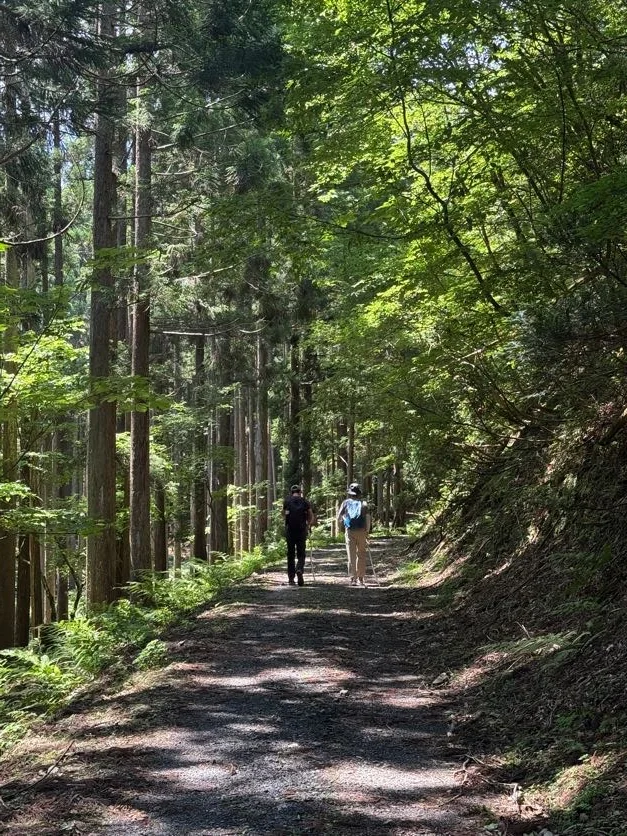
It had been several years since I had hiked this portion of the trail, so I was relieved when two other hikers arrived who shared the same intended destination. We made our way slowly along an old, overgrown logging road beside a stream, then turned onto a tortuous series of switchbacks through tall, narrow cedars. As we climbed higher, the cedars gave way to deciduous forest. The last time I hiked this section, it had been raining and I was walking with a large group, so I had not noticed just how lovely this forest was. At last we reached the pass, where a stone Jizō, patron saint of travelers, greeted us as it had countless others.
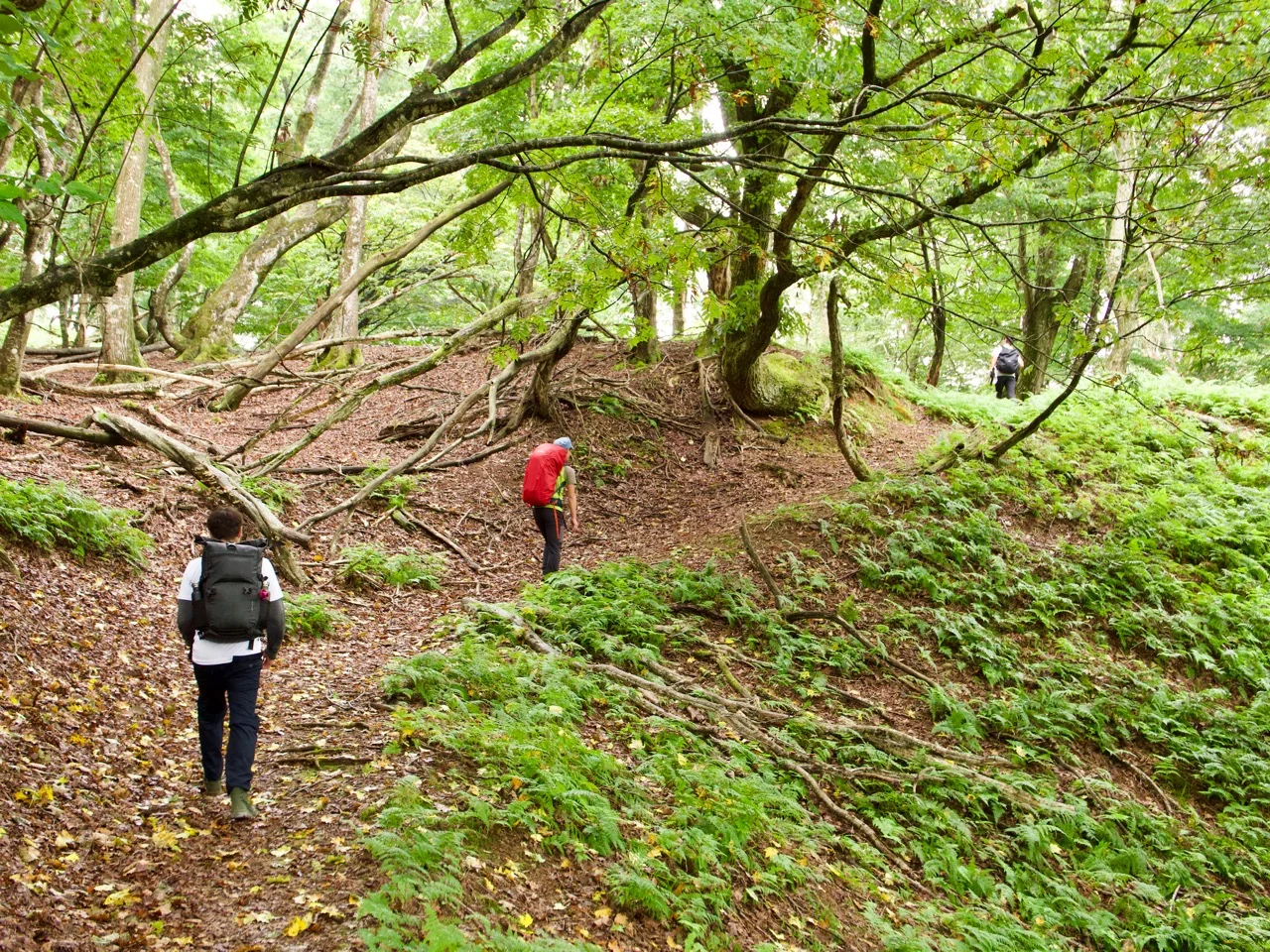
Beyond the pass, the forest suddenly opened onto Hacchō-daira, a broad highland meadow unlike anything we had encountered thus far, and a place worthy of a visit in its own right. At first glance, it appears to be little more than a clearing on the plateau, but beneath the grass lies one of western Japan’s few high moors. Formed when an ancient landslide dammed the valley, the wetland has quietly accumulated layer upon layer of peat for tens of thousands of years. Those buried layers preserve a remarkable record of past climates and vegetation, while the surface supports sphagnum moss and a host of rare plants and insects more commonly associated with far colder regions.
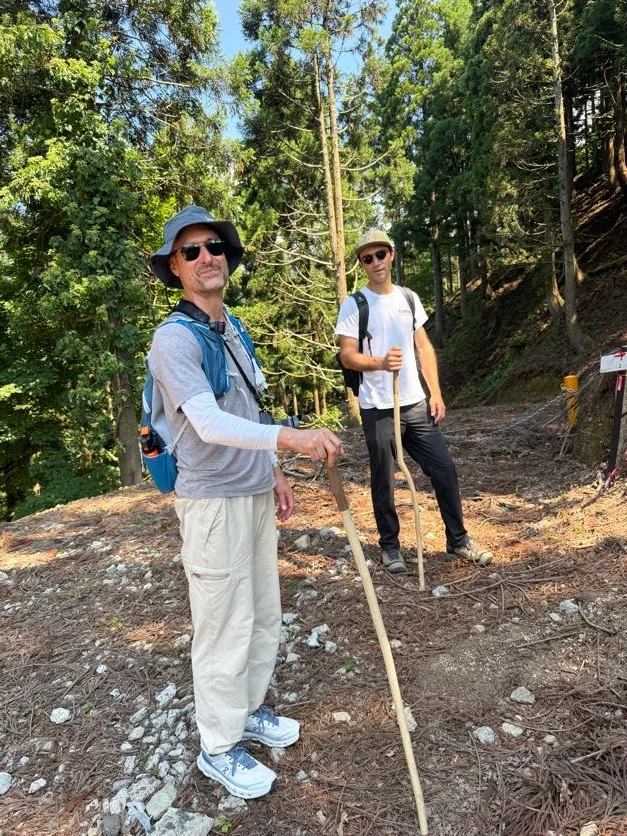
We sat on a bench in the shade of a large beech tree to eat our lunch of rice balls flavored with kelp and pickled plums, greeting several more hikers who had made their way to this unusual landscape, accessible only on foot. We then crossed wooden boardwalks over meandering streams and continued along the narrow trail. The breeze carried the scent of wet earth, and the sounds of birds and insects filled the air.
Before long, we were descending again through cedar forest and arrived at a deserted campground. The road led to the hamlet of Oharaogosecho. It was here, when I first walked the Saba Kaido five years ago, that I met a 93-year-old man who lived in a 350-year-old house. There was no sign of him this time, unfortunately, but his garden seemed well tended. He had told me that, as a child, he remembered seeing fish porters jogging past this very house with baskets of salted fish bouncing on their backs, relaying their cargo toward Kyoto.
At the far end of the hamlet, the paved road gave way to a gravel logging road, and we passed a small moss-covered shrine dedicated to Shikobuchi, the protector deity of the men who once guided timber rafts down these rivers. According to myth, Shikobuchi subdued the river spirits that threatened the rafts.
The Road Ahead
Our weary legs eventually carried us to the top of Hanase Pass, where a smiling Keijiro was again waiting for us, his camera snapping away. We paused to gaze at Lake Biwa through the trees, then piled into the van one last time to descend the long and winding road to Kyoto.
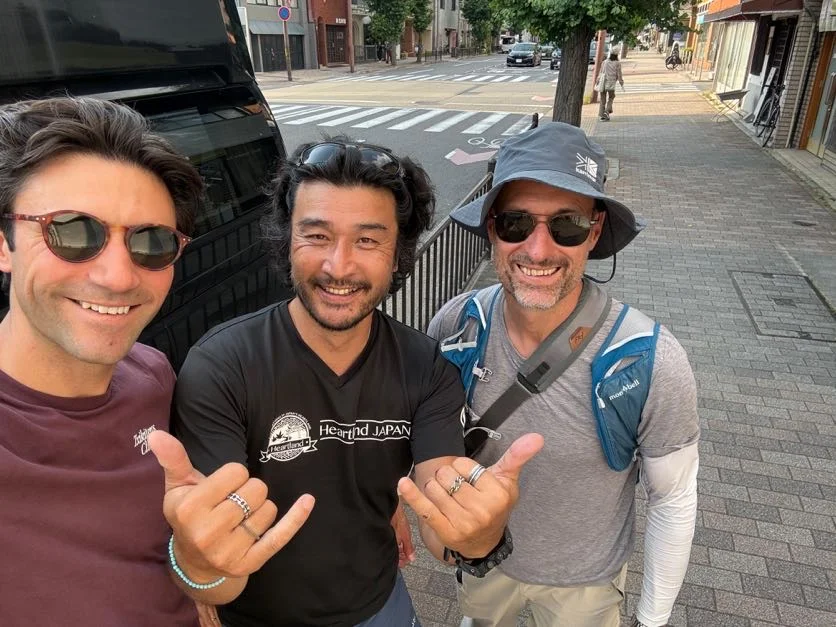
Around this time next year, I hope to be leading a group of high school students from overseas along these same mountain paths, continuing in some small way the Saba Kaido’s centuries-old role as a conduit between Japan and the outside world. The fish porters and Buddhist emissaries may be gone, but the road still has plenty of stories to tell.
If reading this has inspired you to experience the Saba Kaido for yourself, the team at Heartland Japan can help you plan a journey along this remarkable historic route.