
In the Edo period, the Nakasendo was one of the five great highways of Japan — a 530-kilometer inland road connecting Kyoto and Edo (today’s Tokyo) through the mountains, strung with sixty-nine post towns where travelers ate, slept, and traded news. Today it is the most rewarding way to walk into old Japan. But here is the thing nobody tells you at the planning stage: you are not going to walk 530 kilometers. You are going to choose a section — and which section you choose will shape your entire experience.
Having walked, guided, and re-walked this road for years, here is our honest guide to the three ways to do it.
Why the Nakasendo, of All Japan’s Trails?
Unlike a mountain trek, the Nakasendo is a walk through living history. The trail follows the actual stones that daimyo processions, merchants, and poets trod for centuries — Basho among them. Its best-preserved stretch runs through the Kiso Valley, where the road threads between forested peaks and post towns that have kept their wooden lattices, sake breweries, and inns. You walk from town to town the way travelers always did, and at night you sleep where they slept.
The question is not whether to walk it. The question is how deep you want to go.
Option 1: Magome to Tsumago — The Famous Day Walk
The eight-kilometer walk between Magome and Tsumago is the Nakasendo’s postcard: two beautifully restored post towns joined by an old stone path over a gentle pass, walkable in two to three hours. There are waterfalls, bear bells to ring, a teahouse at the top where a volunteer pours you a cup, and luggage forwarding between the towns so you can walk with a daypack. Access is easy — local buses connect both towns to Nakatsugawa and Nagiso stations on the main rail line.
It is deservedly popular, and that is its only drawback. Arrive midday in high season and you will share the path with day-trippers from Nagoya and half the internet’s travel bloggers. The magic is real — but it is strongest early in the morning and after four in the afternoon, when the tour buses leave and the towns fall quiet. If you can stay overnight in Tsumago rather than passing through, you will meet an entirely different place: lantern-lit streets, dinner at a family-run inn, and the road to yourself at dawn.
Option 2: Deeper into the Kiso Valley — Two Days, Half the Crowds
North of the famous pair, the Kiso Valley keeps going — and most walkers don’t. This is where the Nakasendo starts to feel like a discovery again. Narai, once called “Narai of a thousand houses,” has the longest preserved post-town streetscape in Japan, a full kilometer of dark-timbered buildings that housed travelers preparing for the Torii-toge pass. The pass itself, between Yabuhara and Narai, is a quiet forest climb past a shrine gate with a view of sacred Mt. Ontake — the crossing that gave it its name.
Walking this deeper stretch over two days — post town to post town, with a night at a local inn — gives you the full rhythm of the old road: morning mist on the river, soba for lunch, the evening bath, and streets that empty completely after dark. It is only marginally harder than the Magome–Tsumago walk — about six kilometers over a higher pass — but it feels a world quieter. From Narai you can continue on to Matsumoto or back down to Nakatsugawa.
Option 3: The Ontake Kodo — Five Days on the Pilgrim’s Road
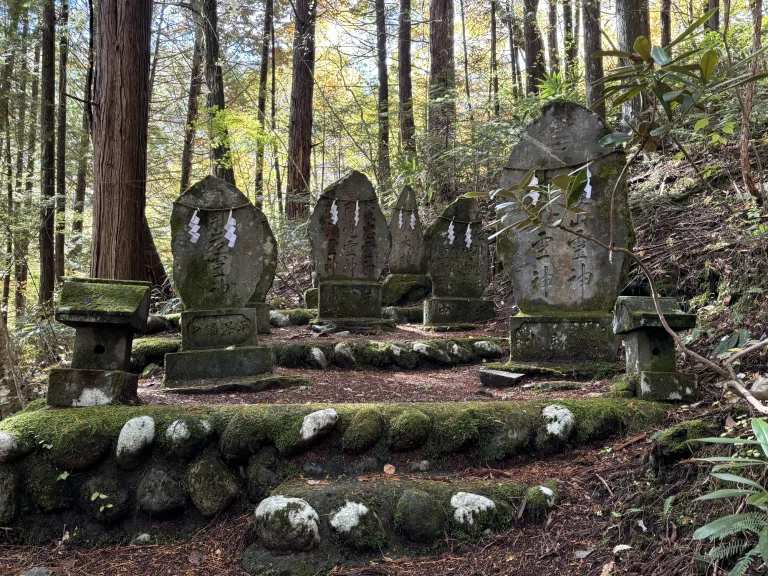
There is a third Nakasendo, older and stranger than the postcard. From the Kiso Valley, pilgrimage paths branch toward Mt. Ontake, the 3,067-meter volcano that has been worshipped as a living deity for centuries. White-clad pilgrims still climb it; the roadside is lined with stone monuments raised by generations of believers. Our five-day route follows the old highway and these pilgrim paths together — through post towns, cypress forests, and mountain hamlets where you will likely be the only foreign travelers that week.
Five days is long enough for the road to change you a little. You settle into the pace. You learn to make soba noodles from a local master, taste sake brewed with Kiso water, and understand why travelers once considered this valley the heart of Japan. This is the section for walkers who want a journey, not a highlight.
Side by Side
| Magome–Tsumago | Deeper Kiso Valley | Ontake Kodo | |
|---|---|---|---|
| Length | 8 km | 2 days, town to town | 5 days |
| Crowds | Busy midday in season | Light | Almost none |
| Difficulty | Easy; one gentle pass | Easy–moderate | Moderate; daily walking |
| Where you stay | Day trip, or one inn night | Post-town inns | Local inns and lodges |
| Feels like | A beautiful highlight | A quiet discovery | A pilgrimage |
So Which Section Is Right for You?
Walk Magome–Tsumago if you have one spare day between Kyoto and Tokyo and want the essence of the old road. Do it right: stay the night in Tsumago and walk early. Book ahead — the inns in Ochiai, Magome, O-tsumago, Tsumago, Yabuhara, and Narai are few, and they fill up.
Walk the deeper Kiso Valley if you have two days and would trade a little fame for a lot of quiet — Narai and the Torii-toge pass are, for our money, the most atmospheric stretch of the entire highway.
Walk the Ontake Kodo if you want the road as travelers actually knew it: day after day, shrine after shrine, with the sacred mountain always at the edge of the view. It asks more of your legs and gives far more back.
Walking the Nakasendo with Heartland Japan
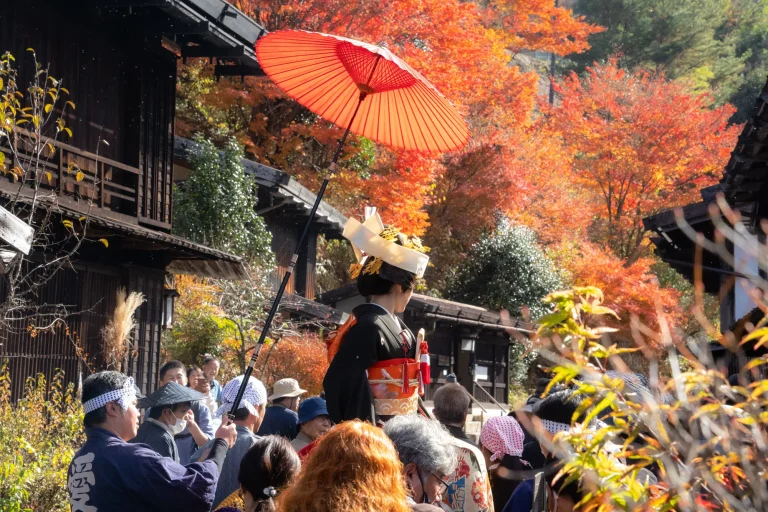
The Kiso Valley is one of our home regions, and we run the Nakasendo at all three depths. Our two-day Kiso Valley journey covers the trail’s most timeless stretch with a night at a traditional inn:
For the full pilgrim’s road — five days on the Ontake Kodo with an English-speaking guide, luggage transfers, and a soba-making session with a local master:
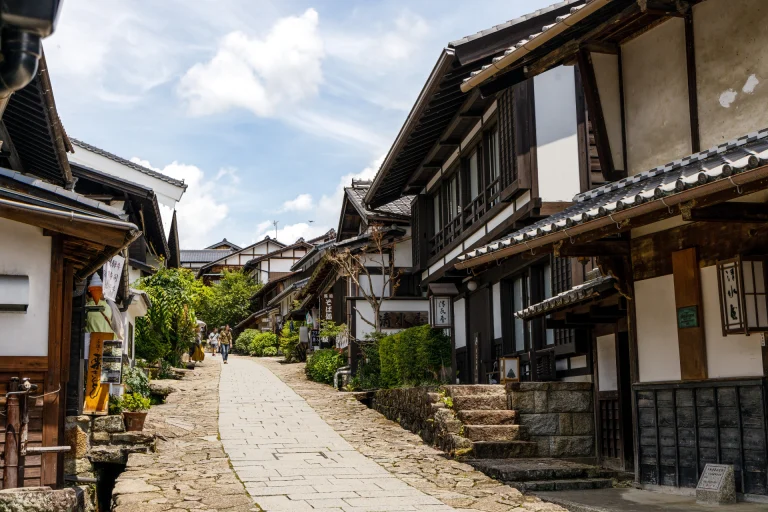
And for travelers who want the Nakasendo woven into a no-compromise, twelve-day private journey from the mountains to the historic capitals, there is our luxury route:
One more secret: the post towns under snow, streets silent and roofs white, may be the most beautiful Nakasendo of all.
Read More About the Nakasendo
We have walked this road many times — here is more from the valley:
Frequently Asked Questions
How long does the Magome to Tsumago walk take?
The classic section is about 8 kilometers and takes 2–3 hours at a relaxed pace — longer if you linger in the post towns at either end, which you should. Luggage forwarding between the two towns makes it an easy light-pack day.
Which direction should I walk — Magome to Tsumago, or the reverse?
Magome to Tsumago involves slightly less climbing and is the direction most walkers choose. Starting in Tsumago means a quieter trail in the morning and arriving in Magome for its viewpoints in the afternoon light.
Can you walk the Nakasendo in winter?
Yes — and it may be the most atmospheric season of all, with snow-dusted post towns and almost no other walkers. The two Kiso Valley sections — Magome–Tsumago and Yabuhara–Narai — can be walked right through winter: the snow rarely lies deep, so normal walking gear is usually enough, though we recommend chain spikes for safety, and inns are far easier to book. The Ontake Kodo is different — it gets real snow and calls for winter equipment such as snowshoes or crampons. Because some passes reward proper footwear and local knowledge, our winter departures are guided.
Do I need a guide for the Nakasendo?
For the Magome–Tsumago day walk, no — it is well signed. For multi-day walks through the deeper Kiso Valley or the Ontake Kodo, a guide transforms the logistics (inns, luggage, trains) and the experience: the trail’s history lives in details you will not find on the signboards.
Where should I stay along the Nakasendo?
In the post towns themselves — family-run ryokan and minshuku inside Edo-period buildings. Kiso-Fukushima makes a convenient base with good rail access and a wider choice of inns.